
How to Check Criminal History in Louisville
Start a Louisville search by naming the record needed. A police narrative, city citation, jail booking, county case file, and statewide history answer different questions. Louisville has no published citywide name-search database, so official telephone, counter, mail, county, and state routes matter.
- Call Louisville Police Department at 478-625-8897 for a city incident or arrest report and confirm identification, request, fee, and pickup rules.
- Ask Louisville Municipal Court about a city citation or ordinance file; use the payment portal only when payment is the goal.
- Call Jefferson County Detention Center at 478-625-7077 for a booking because Louisville arrestees route to the county jail.
- Research filed felony or state misdemeanor cases at the Jefferson County Clerk counter, 202 East Broad Street, or call 478-625-7922.
- Use Georgia Felon Search for its limited statewide felony-conviction scope or GAPS/IdentoGO for an authorized fingerprint check.
Provide a date, location, report or citation number, and the correct name spelling when known. Ask for the public portion if redaction is necessary. A name search can confuse people with similar identifiers, while fingerprints provide stronger identity matching.
Fixing a Louisville Citation Number Search
Louisville publishes a small but important troubleshooting tip. If a citation number fails in its official payment portal, remove the leading letter “T” and enter the remaining number. The portal then collects payment-card details at checkout. This local instruction can save a needless trip, but it does not turn the payment site into a public criminal case database.
A result shows that the system found a payable citation. No result does not prove that Louisville has no citation or court record. The number may be mistyped, the matter may require an appearance, or the item may not yet be eligible for online payment. Call the municipal clerk when the number still fails or when the goal is inspection, a copy, or a certified disposition.
The city explains the process in its official citation instructions. The captured instructions below show the correct Louisville channel.
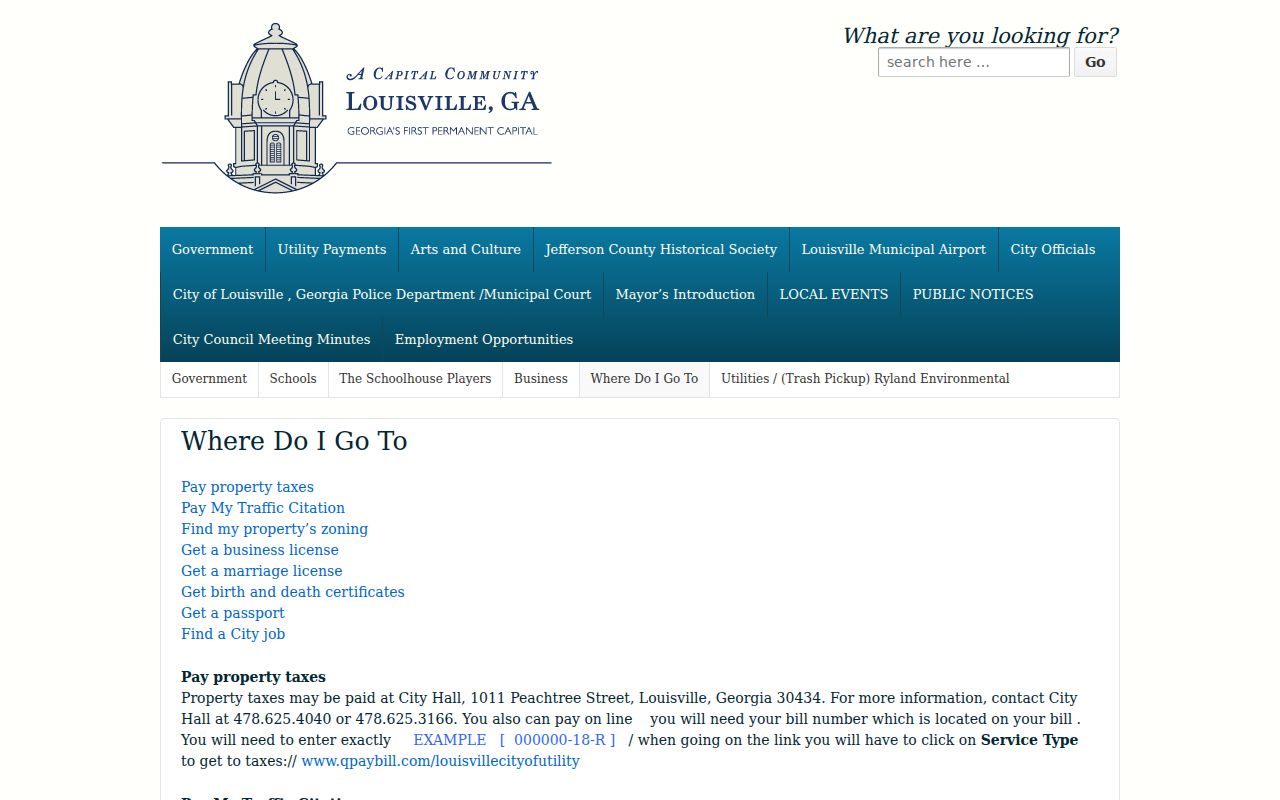
Keep the paper citation and payment confirmation. Neither replaces the Municipal Court docket or final order when the precise outcome matters.
The Louisville Police Department
Louisville Police Department is at 1011 Peachtree Street, Louisville, Georgia 30434. Its published telephone number is 478-625-8897. Jefferson County E-911 lists 478-625-4014 for a nonemergency. An emergency still belongs at 911.
The department is the starting custodian for a Louisville incident or arrest report made by its officers. Describe the event, date, place, involved person, and report number. Call before travel because Louisville does not publish a dedicated records email, report form, fee, counter schedule, arrest log, crime map, or police app. Confirm what identification or proof of involvement is needed and whether a written Open Records Act request is appropriate.
The official department page shown below confirms the city police contact.
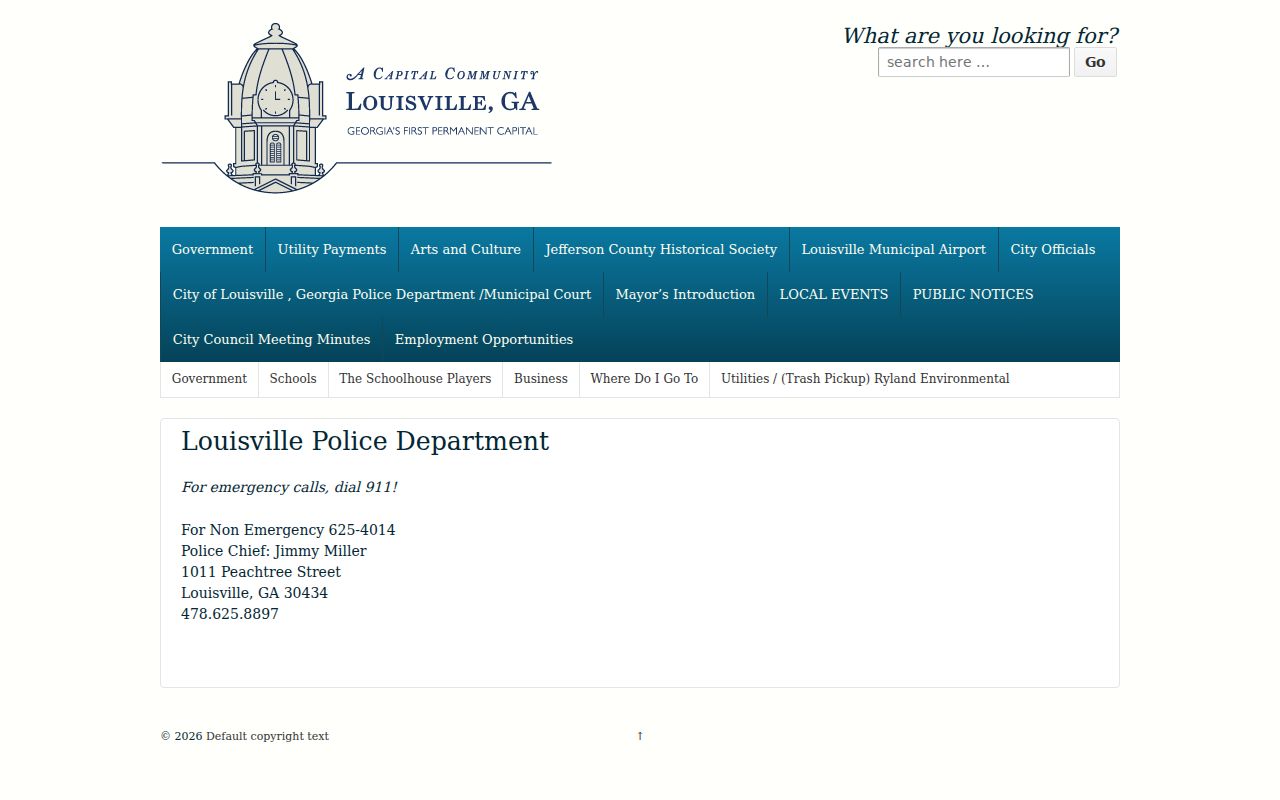
Police reports can contain allegations, witness material, protected identifiers, and investigative details. Requesting the redacted public portion is often more useful than assuming the entire Louisville file is closed.
Louisville Reports, Citations, and County Cases
One Louisville event can create records at several offices. The police report describes the officer response and alleged conduct. The Municipal Court file tracks a city citation. A Jefferson County court file tracks a filed felony or state misdemeanor prosecution. The Sheriff's Office holds the booking record. These files can overlap without being interchangeable.
| Record | Louisville-area custodian | What it establishes |
|---|---|---|
| Incident or arrest report | Louisville Police Department | Officer-created account and listed allegations |
| City citation | Louisville Municipal Court | City charge, events, plea, payment, and result |
| Booking | Jefferson County Sheriff's Office | Intake, holds, bond, release, and listed charges |
| County criminal case | Jefferson County Clerk | Filed charges, pleadings, orders, disposition, and sentence |
A booking sheet proves intake, not guilt. A docket proves that a case exists, not that every count ended in conviction. A reader resolving a Louisville outcome should obtain the final order and compare it with the police and repository record.
Arrests and Bookings in Louisville
A Louisville arrest report begins with the city police, but booking takes place at Jefferson County Detention Center, 911 Clarks Mill Road. The official 2014 county plan said all municipal inmates were brought to the county jail, then the only local inmate housing facility. Since that source describes the arrangement at publication, call 478-625-7077 to confirm current custody and procedure.
The jail creates a distinct intake file that may contain identifiers, fingerprints, listed charges, holds, bond, property, and release events. Louisville has no documented public city arrest log, and Jefferson County has no verified online booking roster. The practical fallback is Louisville Police Department for the report and the detention line for booking status.
If prosecution follows, a city citation stays at Louisville Municipal Court, while felony and state misdemeanor matters move into Jefferson County courts. The Jefferson County arrest history guide explains the county-level sequence without treating an arrest as proof of guilt.
Paying a Louisville Citation at City Hall
Louisville offers three payment channels for an eligible citation. Payment may be made online, in person at the back of City Hall by cash, check, or money order, or mailed to Louisville Municipal Court, P.O. Box 527, Louisville, GA 30434. Checks and money orders are payable to Louisville Police Department.
Payment instructions do not answer whether a court appearance is required, how a plea will be entered, or whether a quoted amount remains current. Read the citation and call the court before choosing a route. Allow delivery time for mail and retain proof. Never infer a clean Louisville history merely because the portal cannot find a number.
The official Louisville payment portal is shown below.
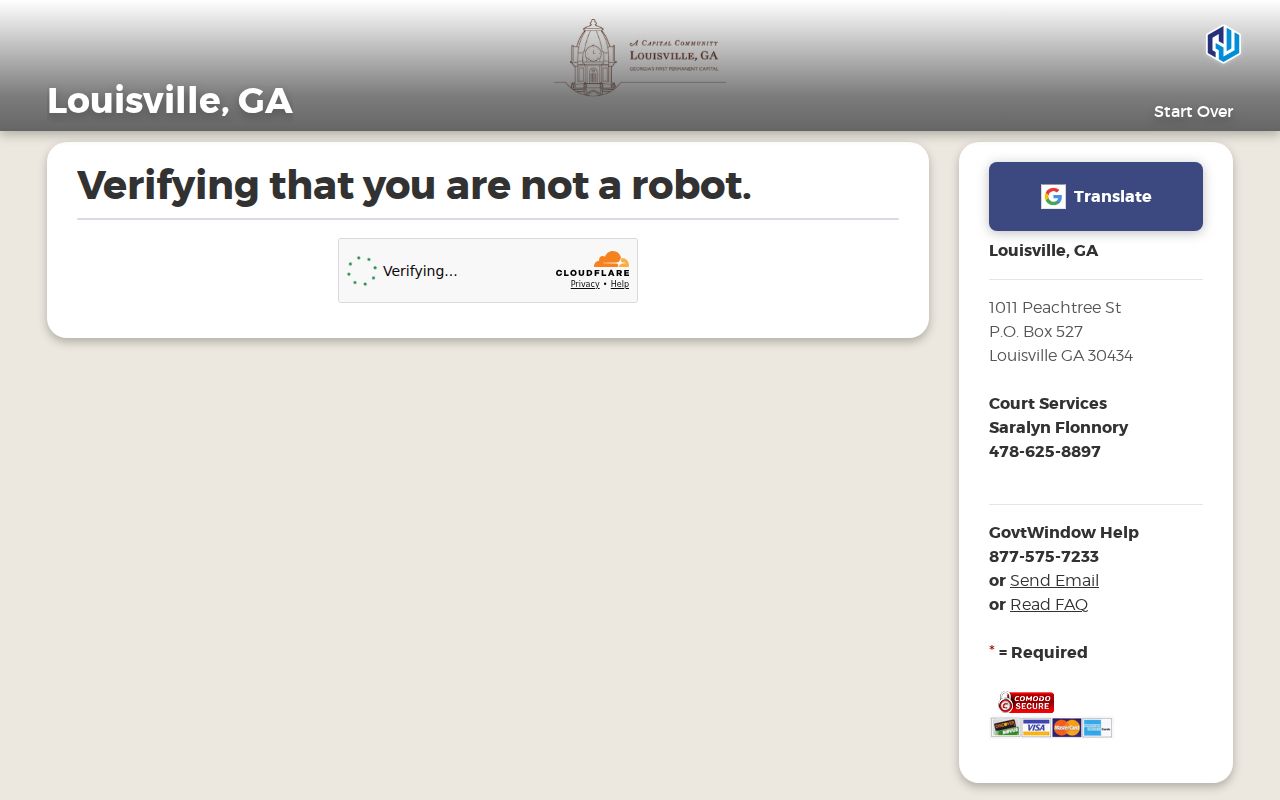
When a record rather than payment is needed, ask the municipal clerk to inspect the docket and request the final disposition in the available form.
Louisville Municipal Court Records
Louisville Municipal Court operates from the 1011 Peachtree Street City Hall complex. Official city information names Clerk Saralyn Flonnory and Judge John Pilcher II. The court handles city ordinance, traffic, and fine-only matters within municipal authority. It is not the Superior Court that hears felony cases.
| Court Name | Louisville Municipal Court |
|---|---|
| Case Types Heard | City ordinance, traffic, and fine-only matters within municipal jurisdiction |
| Lookup Channel | Municipal clerk by phone or counter; payment portal for eligible citations only |
| Typical File Contents | Citation, hearing entries, plea, payment entries, and disposition as applicable |
| Copies and Fees | No city municipal copy fee was published; confirm with the clerk before requesting |
A Louisville bench warrant tied to failure to appear may remain with the issuing municipal court and may not be obvious in a county Superior or State Court inquiry. Resolve a possible warrant with the issuing court or law enforcement. Do not attempt to arrest or confront anyone.
Louisville Records in Georgia's Former Capital
Louisville's civic setting helps explain why city and county records sit close together. Named for King Louis XVI, Louisville was Georgia's third capital and first permanent capital. The 1798 convention adopted the Great Seal here. The Jefferson County Courthouse, built in 1904, occupies the site of the 1795 capitol, and the Old Market House dates to the 1790s.
That history does not change present access law, but it makes the custody split easier to picture. Louisville police and city functions begin on Peachtree Street. Filed county cases are researched at the Clerk's East Broad Street courthouse counter. Older historical or genealogy research should begin with the date and court because modern police files and archival court records follow different custody paths.
The official city homepage provides Louisville civic context.

Louisville's April Buzzard Blast is local color, not a records schedule. Confirm office hours and holiday closures directly before visiting a city counter.
Where Louisville Records End Up
Louisville Police Department creates the city report. Jefferson County Detention Center creates the booking file. A prosecutor and court create charging documents, docket entries, and final orders. Reportable fingerprints and dispositions may then move to the Georgia Crime Information Center, the state's central repository.
Record flow: Louisville Police Department › Jefferson County Courts › Georgia Bureau of Investigation, Georgia Crime Information Center
Recent activity may appear first at Louisville police or the jail. Filed charges belong with the court clerk. A GCIC history is a statewide repository summary, not a scan of every Louisville report or court jacket. Gaps can arise when fingerprints were not sent, identifiers differ, or a disposition has not yet posted. Compare the local final order with an individual's authorized GCIC review before seeking correction.
Statewide Context for Louisville Criminal History
Georgia Felon Search is an official $15 possible-match search using first name, last name, date of birth, and sex. It covers reported Georgia felony convictions, pleas, and sentences. It does not provide a complete Louisville police history, misdemeanors, juvenile matters, or restricted and sealed records. The fee applies even when no match appears, and opening a possible-match record may cost another $15.
For an authorized fingerprint check, Georgia Applicant Processing Service uses IdentoGO, an agency service code, registration, an appointment, and photo identification. A person seeking their own national FBI Identity History Summary must use the FBI's subject-only process. These routes are identity or repository products, not substitutes for a Louisville Municipal Court disposition.
The federal courthouse page captured below represents another separate layer.
Federal cases require the proper United States District Court and PACER channels. A Louisville city citation does not become federal merely because the event occurred in Louisville.
Louisville Population and Record Context
The Census Vintage 2025 estimate ranks Louisville first among Jefferson County's incorporated cities, with 2,237 residents as of July 1, 2025. The April 2020 estimate base was 2,384. Those figures determine why Louisville receives a city guide, but they are not crime rates and should never be used to guess how many people have a criminal record.
No official city-specific crime count was located. The county's reported totals cannot be apportioned to Louisville. A 2023 joint plan listed five full-time and one part-time sworn officer, but that is plan-vintage information rather than a verified current roster. Current staffing should be confirmed with the city.
These limits matter. Searchers should rely on the actual Louisville report, docket, booking, or official repository response instead of drawing conclusions from population, staffing, or countywide crime data.
Public Access Rules for Louisville Records
The Georgia Open Records Act presumes Louisville public records open unless an exemption applies. Send a police request to the city custodian and a court request to the clerk holding that file. An office may redact protected identifiers, victim details, or investigative information while producing the public remainder. Juvenile, sealed, and restricted information does not become public merely because it is requested.
Key Statutes:
O.C.G.A. § 50-18-70 presumes public records open unless a legal exemption applies.
O.C.G.A. § 50-18-71 governs inspection, copying, reasonable charges, and the three-business-day response framework.
O.C.G.A. §§ 35-3-34 and 35-3-35 govern dissemination of Georgia criminal-history and specified felony information.
O.C.G.A. § 35-3-37 provides correction, record restriction, and related remedies for eligible records.
If Louisville cannot produce a record within three business days, its response should address availability and legal grounds for withholding. Ask for redacted public portions. For an error, gather the Louisville report and certified final disposition, then follow the GBI correction or record-restriction process that fits the record.